Thursday, January 20, 2011
Downloading a “Movie” or a “Microbe”?
Monday, December 20, 2010
Backtrack-linux
LINUX-BACKTRACK
The Best Operating System for Hackers.
- Based on: Debian, Ubuntu
- Origin: Switzerland
- Architecture: i386
- Desktop: Fluxbox, KDE
- Category: Forensics, Rescue, Live Medium
- Cost: Free
- Metasploit integration
- RFMON Injection capable wireless drivers
- Kismet
- Nmap
- Ettercap
- Wireshark (formerly known as Ethereal)
- BeEF (Browser Exploitation Framework)
- Information Gathering
- Network Mapping
- Vulnerability Identification
- Web Application Analysis
- Radio Network Analysis (802.11, Bluetooth, Rfid)
- Penetration (Exploit & Social Engineering Toolkit)
- Privilege Escalation
- Maintaining Access
- Digital Forensics
- Reverse Engineering
- Voice Over IP
Monday, November 22, 2010
BACKTRACK 4....lets start with it...
Today, we will review another high-end, security-oriented distribution, BackTrack.

Introduction
BackTrack is one of the more popular distributions in the white hat circles. It is specially suited for penetration testing, with more than 300 tools available for the task. Like both Helix and Protech, BackTrack is based on Ubuntu. This means good stability and hardware detection and a whole lot of software that can be easily obtained.
Sound quite interesting. Let's see how it behaves. We're going to check version 4 Beta.
Lots of great stuff
Like most Linux distros - and definitely all forensics/security-oriented tools, BackTrack works primarily as a live CD, with good hardware detection and low memory footprint, intended to make it usable even on older machines. It is also possible to install BackTrack, should one desire.
The boot menu is simple and elegant, with three options.

The second option (Console no FB) stands for Console no Framebuffers, i.e. the failsafe mode with minimal graphics that should work well on all hardware. Thanks k finity! As to the third option, MSRAMDUMP, I did try booting it, but this produced an error and threw me back into the boot menu.
Anyhow ...
The distro maintains its elegance by booting into the best-looking console I have seen, with stylish color gradients and mirror effects. You can begin working instantly on the command-line or boot into GUI desktop by issuing startx command.

One thing worth noting in the screenshot above is the mounting error on hda1, which is formatted with Ext4, a relatively new filesystem. In fact, the system I booted BackTrack on hosts a Jaunty install, with the Ext4 root partition. This is something that will probably be solved in future releases.
Desktop
The desktop is simple and functional, running a lightweight KDE3 manager. You get a simple wallpaper with dragon-like theme. Another interesting element is the Run box embedded in the panel, which allows you to run applications without invoking a terminal first.
The network is not enabled by default and you'll have to fire it up manually.
Tools
BackTrack is all about lots and lots of hacking tools. Once again, I'm only going to present the tools, not show you how to use them. These tools are all double-edged swords, and without the right amount of respect, skill and integrity, you may cause more harm than good. Furthermore, do not deploy them in a production environment without the explicit approval from system administrators and INFOSEC people.
The tools can all be found under Backtrack in the menu, arranged into sub-categories. The collection is long and rich and it will take you a long time pouring over all of them, let alone mastering them. Most of the tools are command-line utilities, with menu items a link to the console with the relevant tool running inside it.


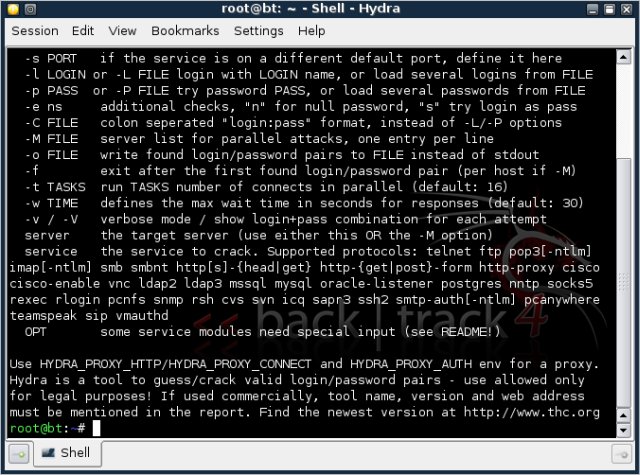
A few practical examples, there's the venerable nmap, Hydra and hping3:
You may also want to audit Bluetooth devices. On the test machine, there are no Bluetooth devices, which explains the error you see below.

Last but not the least, you get the great Wireshark (formerly Ethereal):
Other programs BackTrack is mainly loaded with security applications, however it also has a reasonable assortment of "normal" programs. You get Firefox, already configured to use the exceptional Noscript extension.
You also get Synaptic, which makes software management easy and pleasant:
You also have Wine for Windows software.
And then, you can change wallpapers and get classic KDE looks.

How I miss that wallpaper! To the best of my knowledge, it has not been included in most KDE releases since Kubuntu 6.06.
You can find more stuff in the K-menu:

Errors
Being a beta, BackTrack 4 was not the most stable distro. In addition to the Ext4 error during the boot, there were some other problems. For example, both Lynx text browser and QtParted partitioning software refused to work.

Other things
One thing that may bother you is the issue with the documentation section on the official site. It's secure site, self-signed with an expired certified, at last when this article was written, although the expiration has been in effect since August 2008.
This is not something you expect to see on a site catering to the security-conscious audience.
Furthermore, there's the small issue of inconsistency when it comes to application names. For example, BlueSmash shows up as blue-smash on the command line, hping3 has a capital H in the menus, etc. BackTrack itself also comes in two flavors, with both lowercase and uppercase Ts.
Overall, there were no big issues, except for the occasional application errors.
Conclusion
BackTrack is a powerful hacking suite. It is well made, with stylish touches that add to the overall feel of the distribution. It runs very fast in the live mode, even faster than most installed distributions. Most importantly, the array of tool is rich, well balanced and overall quite impressive.
The Beta version did throw a few errors here and there, but it was nothing major. Small consistency issues also arise, and there's the lack of support for Ext4, which I expect will be solved soon. Documentation needs to be improved, starting with the website SSL certificate and continuing with lots of questions regarding the general usage.
Nevertheless, for security professionals looking for a complete testing package that has all their favorite gadgets neatly arrayed, on top of a stable, popular distribution and with Synaptic package management for easy replenishment of any missing bits, BackTrack is an excellent candidate for their work.
HAVE FUN>>>
Monday, November 8, 2010
BACKTRACK 4 R1... thats what a hacker need
Introduction
BackTrack is the world’s leading penetration testing and information security
auditing distribution. With hundreds of tools preinstalled and configured to run out of the box, BackTrack 4 provides a solid Penetration testing platform ‐ from Web application Hacking to RFID auditing – its all working in once place.
BackTrack is a Linux-based penetration testing arsenal that aids security professionals in the ability to perform assessments in a purely native environment dedicated to hacking
History
BackTrack has a long history and was based on many different linux distributions until it is now based on a Slackware linux distribution and the corresponding live-CD scripts by Tomas M. (www.slax.org) . Every package, kernel configuration and script is optimized to be used by security penetration testers. Patches and automation have been added, applied or developed to provide a neat and ready-to-go environment.
Different version of backtrack.
Date Release
February 5, 2006 BackTrack v.1.0 Beta
May 26, 2006 The BackTrack project released its first non-beta version (1.0).
October 13, 2006 BackTrack 2 first public beta released.
November 19, 2006 BackTrack 2 second public beta released.
March 6, 2007 BackTrack 2 final released.
December 17, 2007 BackTrack 3 first beta release.
June 19, 2008 BackTrack 3 final released.
February 11, 2009 BackTrack 4 first beta release. (It's now based on Debian)
June 19, 2009 BackTrack 4 pre-final release.
January 9, 2010 BackTrack 4 final release.
May 8, 2010 BackTrack 4 R1 release
You can download your new copy of backtarck from :
http://www.backtrack-linux.org/downloads/
Thing you can do with backtrack-4 R1
BackTrack tools are arranged by parent categories. These are the categories
that currently exist:
BackTrack ‐ Enumeration
BackTrack ‐ Tunneling
BackTrack ‐ Bruteforce
BackTrack ‐ Spoofing
BackTrack ‐ Passwords
BackTrack ‐ Wireless
BackTrack ‐ Discovery
BackTrack ‐ Cisco
BackTrack – Web Applications
BackTrack ‐ Forensics
BackTrack ‐ Fuzzers
BackTrack ‐ Bluetooth
BackTrack ‐ Misc
BackTrack ‐ Sniffers
BackTrack ‐ VOIP
BackTrack ‐ Debuggers
BackTrack ‐ Penetration
BackTrack ‐ Database
BackTrack ‐ RFID
BackTrack – Python4
BackTrack – Drivers
BackTrack ‐ GPU
Conclusion
Backtarck 4 R1 is new realease of distributions where you can get all tools which you want. Whether you’re hacking wireless, exploiting servers, performing a web application assessment, learning, or social-engineering a client, BackTrack is the one-stop-shop for all of your security needs.
Tuesday, October 26, 2010
Window 7's "GODMODE"
Although its name suggests perhaps even grander capabilities, Windows enthusiasts are excited over the discovery of a hidden "GodMode" feature that lets users access all of the operating system's control panels from within a single folder.
By creating a new folder in Windows 7 and renaming it with a certain text string at the end, users are able to have a single place to do everything from changing the look of the mouse pointer to making a new hard-drive partition.
The trick is also said to work in Windows Vista, although some are warning that although it works fine in 32-bit versions of Vista, it can cause 64-bit versions of that operating system to crash.
To enter "GodMode," one need only create a new folder and then rename the folder to the following:
GodMode.{ED7BA470-8E54-465E-825C-99712043E01C}
Once that is done, the folder's icon will change to resemble a control panel and will contain dozens of control options. I'm not sure it's my idea of playing God, but it is a handy way to get to all kinds of controls.
For example, the first one could be a folder named "vivek.{00C6D95F-329C-409a-81D7-C46C66EA7F33}"
(use everything inside quotes--but not the quotes themselves).
Here's the list of strings: Try out more example
{00C6D95F-329C-409a-81D7-C46C66EA7F33}
{0142e4d0-fb7a-11dc-ba4a-000ffe7ab428}
{025A5937-A6BE-4686-A844-36FE4BEC8B6D}
{05d7b0f4-2121-4eff-bf6b-ed3f69b894d9}
{1206F5F1-0569-412C-8FEC-3204630DFB70}
{15eae92e-f17a-4431-9f28-805e482dafd4}
{17cd9488-1228-4b2f-88ce-4298e93e0966}
{1D2680C9-0E2A-469d-B787-065558BC7D43}
{1FA9085F-25A2-489B-85D4-86326EEDCD87}
{208D2C60-3AEA-1069-A2D7-08002B30309D}
{20D04FE0-3AEA-1069-A2D8-08002B30309D}
{2227A280-3AEA-1069-A2DE-08002B30309D}
{241D7C96-F8BF-4F85-B01F-E2B043341A4B}
{4026492F-2F69-46B8-B9BF-5654FC07E423}
{62D8ED13-C9D0-4CE8-A914-47DD628FB1B0}
{78F3955E-3B90-4184-BD14-5397C15F1EFC}
And, as a reminder, to create the Godmode folder itself, use this string:
{ED7BA470-8E54-465E-825C-99712043E01C}
Botnet or Zombie--- a web Robot

DEFINITION -A botnet (also known as a zombie army) is a number of Internet computers that, although their owners are unaware of it, have been set up to forward transmissions (including spam or viruses) to other computers on the Internet. Any such computer is referred to as a zombie - in effect, a computer "robot" or "bot" that serves the wishes of some master spam or virus originator. Most computers compromised in this way are home-based
A botnet or robot network is a group of computers running a computer application controlled and manipulated only by the owner or the software source. The botnet may refer to a legitimate network of several computers that share program processing amongst them.
Usually though, when people talk about botnets, they are talking about a group of computers infected with the malicious kind of robot software, the bots, which present a security threat to the computer owner. Once the robot software (also known as malicious software or malware) has been successfully installed in a computer, this computer becomes a zombie or a drone, unable to resist the commands of the bot commander.
A botnet may be small or large depending on the complexity and sophistication of the bots used. A large botnet may be composed of ten thousand individual zombies. A small botnet, on the other hand may be composed of only a thousand drones. Usually, the owners of the zombie computers do not know that their computers and their computers’ resources are being remotely controlled and exploited by an individual or a group of malware runners through Internet Relay Chat (IRC)
There are various types of malicious bots that have already infected and are continuing to infect the Internet. Some bots have their own spreaders – the script that lets them infect other computers (this is the reason why some people dub botnets as computer viruses) – while some smaller types of bots do not have such capabilities.
Different Types of Bots
Here is a list of the most used bots in the Internet today, their features and command set.
XtremBot, Agobot, Forbot, Phatbot
These are currently the best known bots with more than 500 versions in the Internet today. The bot is written using C++ with cross platform capabilities as a compiler and GPL as the source code. These bots can range from the fairly simple to highly abstract module-based designs. Because of its modular approach, adding commands or scanners to increase its efficiency in taking advantage of vulnerabilities is fairly easy. It can use libpcap packet sniffing library, NTFS ADS and PCRE. Agobot is quite distinct in that it is the only bot that makes use of other control protocols besides IRC.
UrXBot, SDBot, UrBot and RBot
Like the previous type of bot, these bots are published under GPL, but unlike the above mentioned bots these bots are less abstract in design and written in rudimentary C compiler language. Although its implementation is less varied and its design less sophisticated, these type of bots are well known and widely used in the internet.
GT-Bots and mIRC based bots
These bots have many versions in the Internet mainly because mIRC is one of the most used IRC client for windows. GT stands for global threat and is the common name for bots scripted using mIRC. GT-bots make use of the mIRC chat client to launch a set of binaries (mainly DLLs) and scripts; their scripts often have the file extensions .mrc.
Malicious Uses of Botnets
A botnet can have a lot of malicious applications. Among the most popular uses of botnets are the following:
Denial of Service Attacks
A botnet can be used as a distributed denial of service weapon. A botnet attacks a network or a computer system for the purpose of disrupting service through the loss of connectivity or consumption of the victim network’s bandwidth and overloading of the resources of the victim’s computer system. Botnet attacks are also used to damage or take down a competitor’s website.
Any Internet service can be a target by botnets. This can be done through flooding the website with recursive HTTP or bulletin-board search queries. This mode of attack in which higher level protocols are utilized to increase the effects of an attack is also termed as spidering.
Spamming and Traffic Monitoring
A botnet can also be used to take advantage of an infected computer’s TCP/ IP’s SOCKS proxy protocol for networking applications. After compromising a computer, the botnet commander can use the infected unit (a zombie) in conjunction with other zombies in his botnet (robot network) to harvest email addresses or to send massive amounts of spam or phishing mails.
Moreover, a bot can also function as a packet sniffer to find and intercept sensitive data passing through an infected machine. Typical data that these bots look out for are usernames and passwords which the botnet commander can use for his personal gain. Data about a competitor botnet installed in the same unit is also mined so the botnet commander can hijack this other botnet.
Key logging and Mass Identity Theft
Encryption software within the victims’ units can deter most bots from harvesting any real information. Unfortunately, some bots have adapted to this by installing a key logger program in the infected machines. With a key logger program, the bot owner can use a filtering program to gather only the key sequence typed before or after interesting keywords like PayPal or Yahoo mail. This is one of the reasons behind the massive PayPal accounts theft for the past several years.
Bots can also be used as agents for mass identity theft. It does this through phishing or pretending to be a legitimate company in order to convince the user to submit personal information and passwords. A link in these phishing mails can also lead to fake PayPal, eBay or other websites to trick the user into typing in the user name and password.
Botnet Spread
Botnets can also be used to spread other botnets in the network. It does this by convincing the user to download after which the program is executed through FTP, HTTP or email.
Pay-Per-Click Systems Abuse
Botnets can be used for financial gain by automating clicks on a pay-per-click system. Compromised units can be used to click automatically on a site upon activation of a browser. For this reason, botnets are also used to earn money from Google’s Adsense and other affiliate programs by using zombies to artificially increase the click counter of an advertisement.
CONCLUSION
What is certain is that botnets are widespread and growing, even attracting teenagers known as “script kiddies” who compete in building botnets. As a result, savvy computer users and administrators are taking steps to guard against rootkits that hand over access to hackers and script kiddies. Anti-rootkit software can be used to scan for existing rootkits, and other precautions can also be taken to minimize the risks of becoming part of a botnet.